


When you bite into a juicy, crisp European apple, you are experiencing the final result of an incredibly complex process. Behind its exquisite freshness and excellent taste lies not chance, but an intelligent, precise system that combines a deep respect for nature with modern technology.
We invite you to a European orchard—see how this meticulous attention to detail translates into quality you can fully trust!
Precision and Modernity: The Daily Life of a European Apple Grower
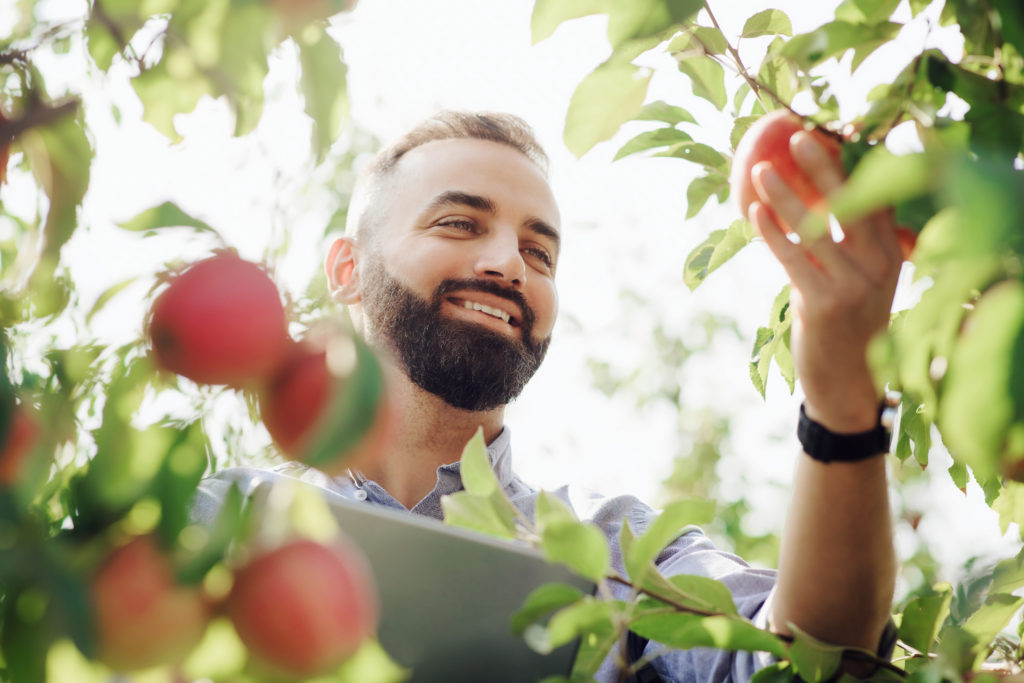
A modern European orchard is a technologically advanced ecosystem where every decision is based on data and knowledge. Instead of reacting to problems, professional growers prevent them. How do they do it?
- Data-Driven Monitoring: Pheromone traps are placed at strategic points throughout the orchard. These are not ordinary insect traps—they are advanced monitoring tools that allow for a precise assessment of pest populations. Thanks to them, the grower knows if and when an intervention is necessary at all.
- In-House Weather Stations: Many farms have advanced meteorological stations that collect data on humidity, temperature, and precipitation. This information feeds into predictive models that warn of the risk of fungal diseases in advance, allowing for preventive action!
- Nature as a Priority: Chemical intervention is the absolute last resort. Before it is considered, a whole arsenal of biological methods is employed. This includes introducing beneficial organisms into the orchard’s ecosystem, which naturally control pest populations.
This approach, where knowledge, data, and technology allow for the minimization of plant protection products, is called Integrated Pest Management (IPM)¹.
The Power of a European Standard
These advanced practices are not merely the voluntary choice of the best growers. Integrated Pest Management is an official, legally regulated standard that applies to all professional farmers across the entire European Union¹!
It is not a single method, but a complete, multi-stage strategy based on ironclad principles. According to this strategy, chemical plant protection products (pesticides) are treated like a surgeon’s scalpel—used only when absolutely necessary, not as a one-size-fits-all solution. The foundation of Integrated Pest Management is an intelligent hierarchy of actions¹:
- Prevention is Key: Everything begins with prevention. This includes selecting resistant apple varieties, ensuring healthy, fertile soil, and using appropriate crop rotation, which naturally strengthens the entire orchard ecosystem.
- Data-Based Decisions: Action is not taken “just in case,” but only after the so-called economic injury level is crossed. This means intervention occurs only when monitoring (e.g., via the aforementioned pheromone traps) shows that a pest population has reached a level at which it could genuinely threaten the harvest.
- Non-Chemical Methods First: When intervention is necessary, priority is given to biological methods (e.g., introducing natural enemies of pests), physical methods (e.g., nets), and other alternative techniques.
- Precision Over Force: If the use of a pesticide is unavoidable, it must be as selective as possible—acting on the specific problem while minimizing impact on beneficial organisms like bees. It is used in minimal, strictly defined doses and at a precisely determined time to maximize its effectiveness and minimize its environmental impact.
What Does This Mean for You?
This intelligent system translates directly into the quality and freshness of the apples that reach the Asian market. By prioritizing biological methods and precise monitoring, European apples are characterized by minimal, strictly controlled pesticide residues².
This is why, when you reach for an apple from Europe, you can be confident that its quality is the result of science, technology, and a deep understanding of nature. It is a systemic approach that puts consumer safety first—from a single, intelligently managed orchard to an entire continent.
Sources:
1 https://www.gov.pl/web/rolnictwo/integrowana-ochrona-roslin
2 https://food.ec.europa.eu/plants/pesticides/sustainable-use-pesticides_en